Rainforest: rain falling through a forest of green
Quiltoku can be played with colours, shapes or patterns. Rainforest is a set of marks taken from a quilt of the same name, made in 1989 by Anne de la Mauvinière Silva. Each mark is one colour with one white line across it, and the line runs a different way in different marks, like rain slanting through a forest.
The quilt
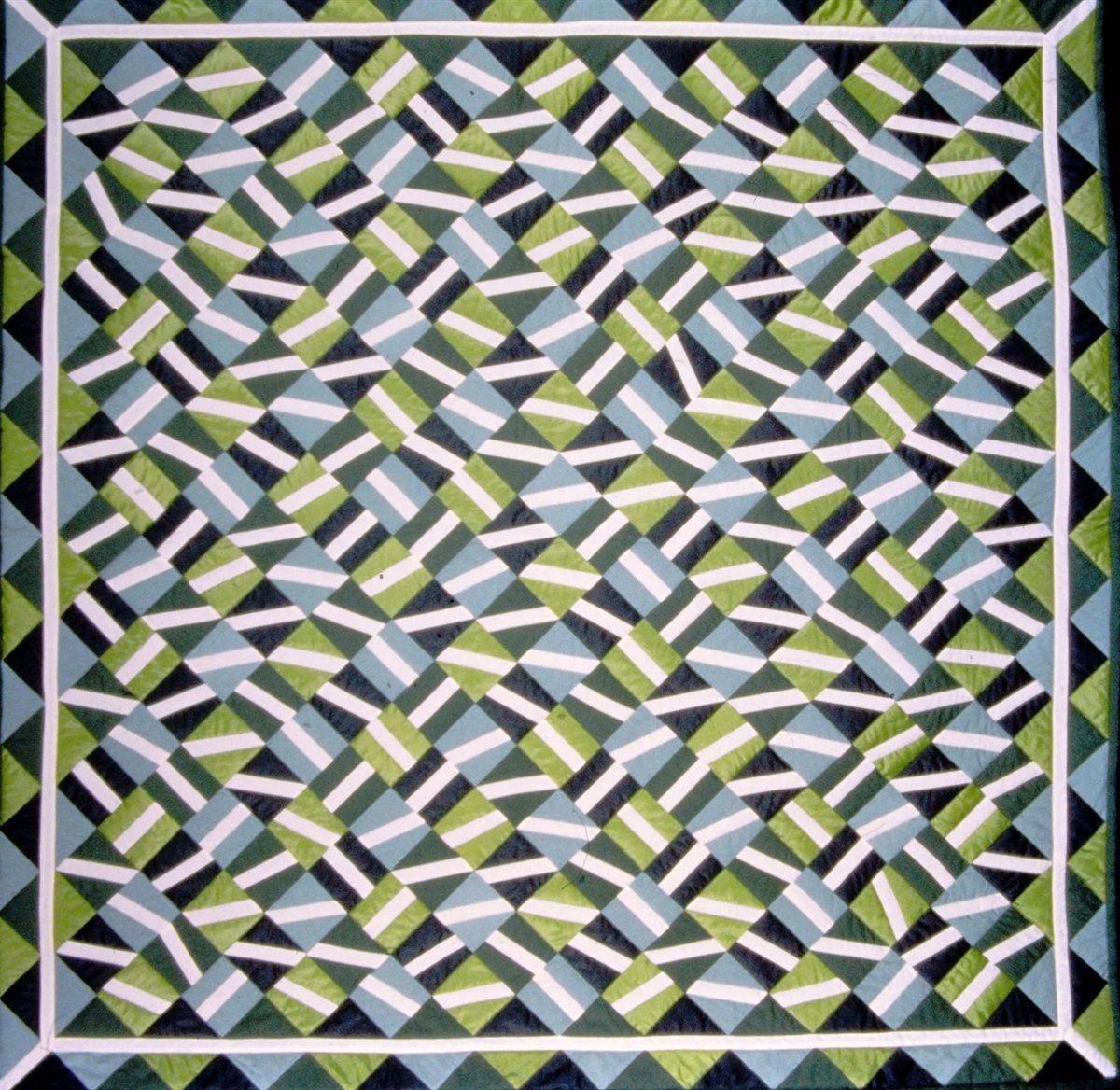
Rainforest is a quilt set on the diagonal. Its blocks are squares turned onto a corner, so they sit as diamonds, and each one is cut across its middle into two triangles of different fabric: a bright lime green, a deep forest green, a soft blue-grey and a near-black navy. Across almost every diamond runs a narrow white strip, and no two strips lie quite alike. Some run level, some lean, a few bend in the middle, so the whole surface seems to move. A thin white line frames the centre, and a border of small triangles in the same four colours closes it in. The first thing the eye finds is a field of green, and then the white strips come forward like rain.
The quilt and its sister quilts are the idea behind Quiltoku. You can read more on the quilt behind Quiltoku, and the black and white marks taken from another quilt by the same maker are on the page Pianissimo.
The marks
Every board needs as many different marks as it has squares along a side: four on a 4×4, six on a 6×6, nine on a 9×9. Rainforest has sixteen, made from four colours and four lines.
The four colours are lime, dark green, blue-grey and navy. The four lines are upright, across, rising to the right and falling to the right. The two slanted lines are drawn a little thicker than the straight ones, so they stay clear on a small square.
The first four. A 4×4 board uses each colour once, and each colour has a different line: lime upright, dark green across, blue-grey rising, navy falling. That is already a small field of rain.
Turn each colour to the next line. Marks five to eight give every colour a second line. A 6×6 board uses the first six, and an 8×8 board all eight.
Two more turns. Marks nine to twelve, then thirteen to sixteen, until every colour has every line. A 9×9 board uses the first nine, a 10×10 the first ten, and the biggest boards all sixteen.
A set that grows this way keeps a small board easy to read, since its four marks differ in both colour and line. A bigger board brings in the same colours with new lines, so you learn the set as you go.
A finished 6×6
This is a solved 6×6 board in Rainforest. Each row, each column and each 2×3 box holds each of the six marks exactly once. Look at how the lines carry across from one square to the next: this is the rain falling across the whole board.
An example puzzle
Here is a small 4×4 puzzle in Rainforest. The rule is the same as in every Quiltoku puzzle: each row, each column and each 2×2 box must hold each of the four marks exactly once. Some marks are already placed. The empty squares are for you.
How to solve it
- Start with the fullest row. The top row has the lime, the dark green and the navy. The one that is missing is the blue-grey with the line rising to the right, so that goes in the empty square.
- Use the boxes. The top-left box now holds three of the four marks, so the empty square in its second row has to be the one that is missing. That leaves the left column needing just one more mark for its third row.
- Finish with the rows and columns. Each empty square now has one mark that fits in its row, its column and its box. The rest follows square by square, and nothing ever has to be guessed.
Try it yourself: open Settings, Style, Marks, choose Rainforest and play a daily puzzle. Switch back to colours whenever you like; your progress is the same either way. Rainforest is for single boards: on a Double the marks show as plain colours.
Why a set like this?
Because every mark has both a colour and a direction, you have two ways to tell them apart, which helps players who cannot rely on colour alone. They are also a way to see the quilt in a puzzle: a few colours, a line, and a different angle each time. For the other kinds of marks, read colours, shapes and patterns, and for the idea behind the whole game, how to solve a puzzle.