The quilt behind Quiltoku
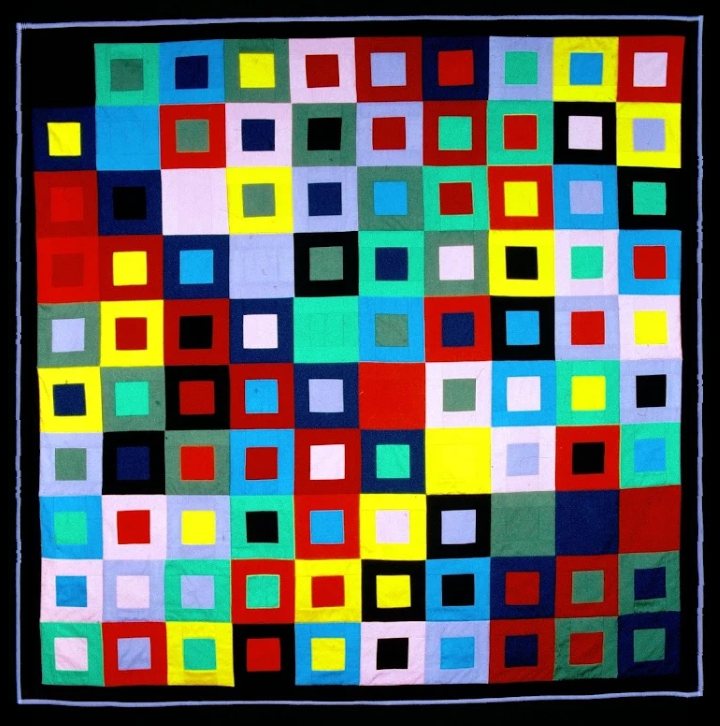
The name, the logo and the Double puzzle all come from one object: a quilt called City Limits, made in 1985 by the developer's mother, the textile artist Anne de la Mauvinière Silva.
Squares inside squares
Look at the quilt and you will see a grid of large squares. Inside every large square sits a smaller one in a different colour. The effect is like a city seen from above, blocks within blocks, which is where the quilt gets its name. Ten colours are used, and there is a pattern to where they go: each colour appears once in every row and once in every column as a large square, and once in every row and column as a small square too, and no pairing of a large colour with a small colour is ever repeated.
That is exactly the structure of a Quiltoku Double puzzle. A Double board is two Latin squares laid over one another, one for the outer squares and one for the inner ones. Seen that way, the quilt is a finished Double puzzle, hung on a wall.
From quilt to logo
The Quiltoku logo is a digital copy of the quilt. In August 2026 the ten colours were picked by hand, patch by patch, against the real thing, with a small map tool that showed the quilt grid. In October the palette was re-matched against a photograph of the quilt, so the logo's burgundy, lemon, red, black, navy, mint, cerulean, sage, pale lavender and periwinkle all come from the fabric itself. When the logo was checked against the quilt, two patches turned out to be wrong, and fixing them also made the grid a perfect Double square. The fix came from checking the real fabric, and afterwards the logo grid worked as a true puzzle answer.
Why the game is called Quiltoku
The "-oku" ending nods to Sudoku, the puzzle it follows, and the first half of the name is the quilt.
Stitching
The fixed squares that come with a puzzle are sewn with a small seam around each patch, and when you finish a puzzle the rest of the board is stitched too, with a short animation. The thread is white on dark colours, black on light ones, and orange on patterns. If you have ever held a quilt up to the light and looked at the seams, that is the picture the stitches are meant to give.
Why no numbers?
A quilt is read with the eyes, not with the head. Number puzzles can feel like arithmetic homework, and colours and shapes keep the attention on pure logic. They also make the puzzle friendlier to people who have never tried Sudoku, and they are easier to read at a glance. Marks that are shapes and patterns exist so that colour is never the only way to play.
A note on credit
City Limits and its photograph may not be copied or reused without written permission. The quilt is credited in the game's About screen, on the About page and at the foot of every page.
Next: look inside the logo, where the quilt turns out to be a Graeco-Latin square, or read about Latin squares and Euler.