Pianissimo: a puzzle in black and white
Quiltoku can be played with colours, shapes or patterns. Pianissimo is a set of patterns taken from a quilt of the same name, made in 1988 by Anne de la Mauvinière Silva. It uses nothing but black strips on white, turned and spaced in different ways, so the marks differ in shape and rhythm and never in colour.
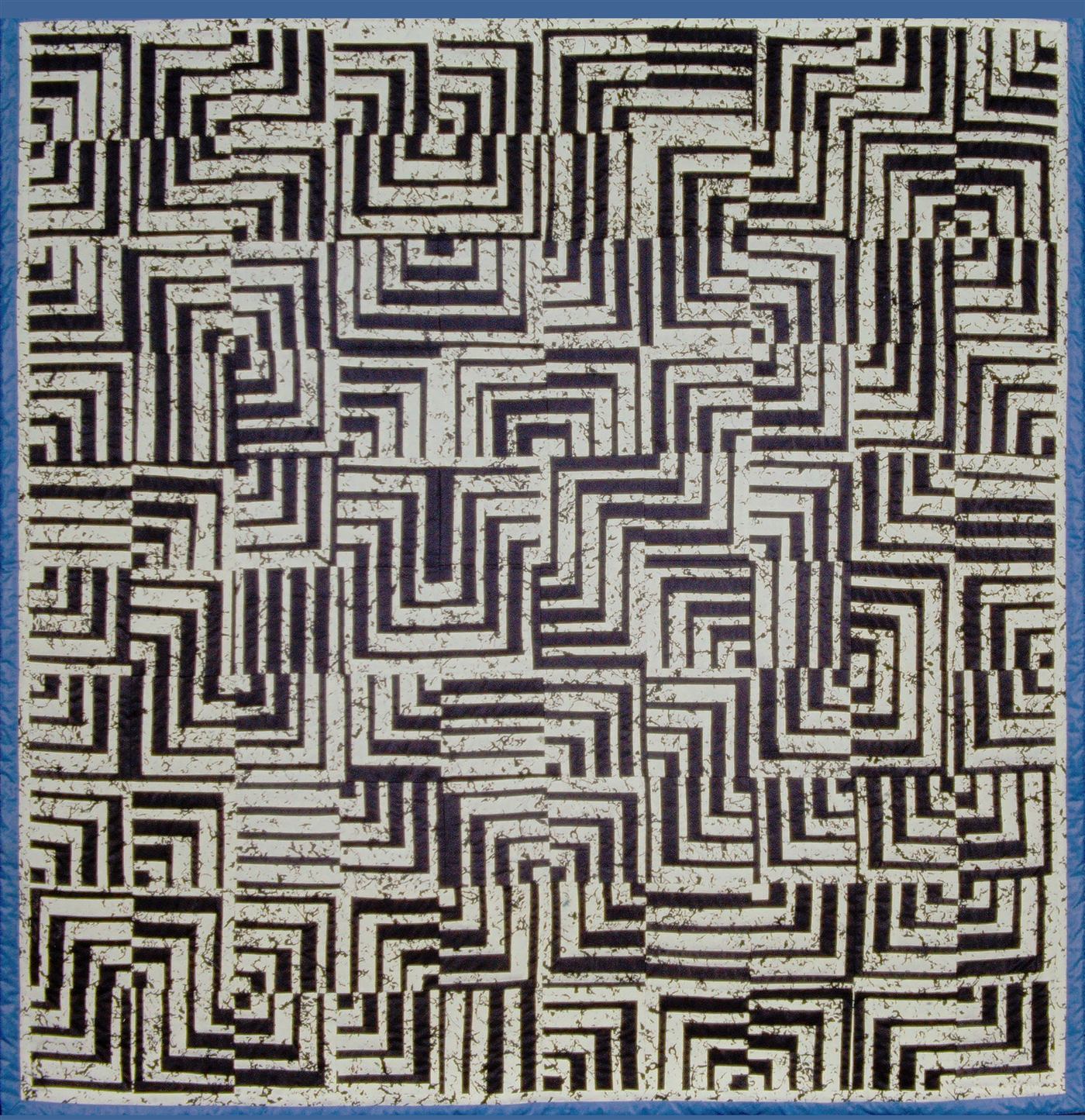
The quilt
Pianissimo is a log cabin style quilt. In a log cabin block, strips of fabric (the "logs") are sewn around a centre, round after round, so the strips nest inside each other. Here the strips are black on a white fabric flecked with black. The quilt plays with that binary theme: it varies how many strips there are, how thick they are and how each block is turned a quarter from its neighbour. The strips of one block run on into the next, so the eye follows them like paths, and the alternating bars bring a piano keyboard to mind. In music, pianissimo means very softly. You can read more on the quilt behind Quiltoku, where its sister quilt City Limits gave the game its name and its logo.
The marks
Every board needs as many different marks as it has squares along a side: four on a 4×4, six on a 6×6, ten on a 10×10. Pianissimo grows with the board, adding a little at a time, up to sixteen.
Four corners. A 4×4 board uses one corner of two nested strips, a fat strip along one direction and a thin strip along the other, turned a quarter each time. The fat and thin strips are what make it feel most like the quilt, which is full of thick and thin bars side by side.
Piano keys. A 6×6 board adds two sets of bars, running across and running upright.
The other direction. 9×9 and 10×10 boards add four more corners, this time with the fat strip along the other direction.
The biggest boards. The plain three-strip corners and keys made of three fat bars are saved for the largest boards, up to 16×16.
An example puzzle
Here is a small 4×4 puzzle in Pianissimo. The rule is the same as in every Quiltoku puzzle: each row, each column and each 2×2 box must hold each of the four marks exactly once. Some marks are already placed. The empty squares are for you.
How to solve it
- Start with the fullest row. The top row already has three of the four marks. The one that is missing is the corner that sits in the bottom-right of its square, so that is what goes in the empty square.
- Use the boxes. The top-left box now holds three marks, so the empty square in its second row has to be the one that is missing. That leaves the left column needing just one more mark for its third row.
- Finish with the rows and columns. Each empty square now has one mark that fits in its row, its column and its box. The rest follows square by square, and nothing ever has to be guessed.
A bigger one: ten by ten
The quilt is a big grid, and so is this example: a 10×10 Latin puzzle, the same size as the quilt. A Latin puzzle has no boxes. Every row and every column must hold each of the ten marks exactly once, and that is all. The puzzle is on the left, with 48 marks placed and 52 empty squares, and its one solution is on the right. The solved board is like a quilt of its own: ten different blocks, none repeated in any row or column.
Try it yourself: open Settings, Style, Marks, choose Patterns (the Pianissimo marks) and play the daily puzzle. Switch back to colours whenever you like; your progress is the same either way.
Why a set like this?
Because the marks are black and white and differ in shape and thickness, they work for everyone, including players who cannot rely on colour. They are also a way to see the quilt in a puzzle: one corner, turned and repeated, and always something new. For the other kinds of marks, read colours, shapes and patterns, and for the idea behind the whole game, how to solve a puzzle.